Compress a PDF to 20KB for a Government Form
Some government and exam forms demand astonishingly small files. A signed declaration, a single-page form or a scanned signature page often has to come in at 20 KB or less, and that is small enough that ordinary compressors simply cannot manage it reliably. If you have been searching how to compress a PDF to 20 KB for a government form and keep getting files that are still too big — or so degraded they are rejected as unreadable — this page explains why, and how to actually hit 20 KB.
Why 20 KB is so hard for normal compressors
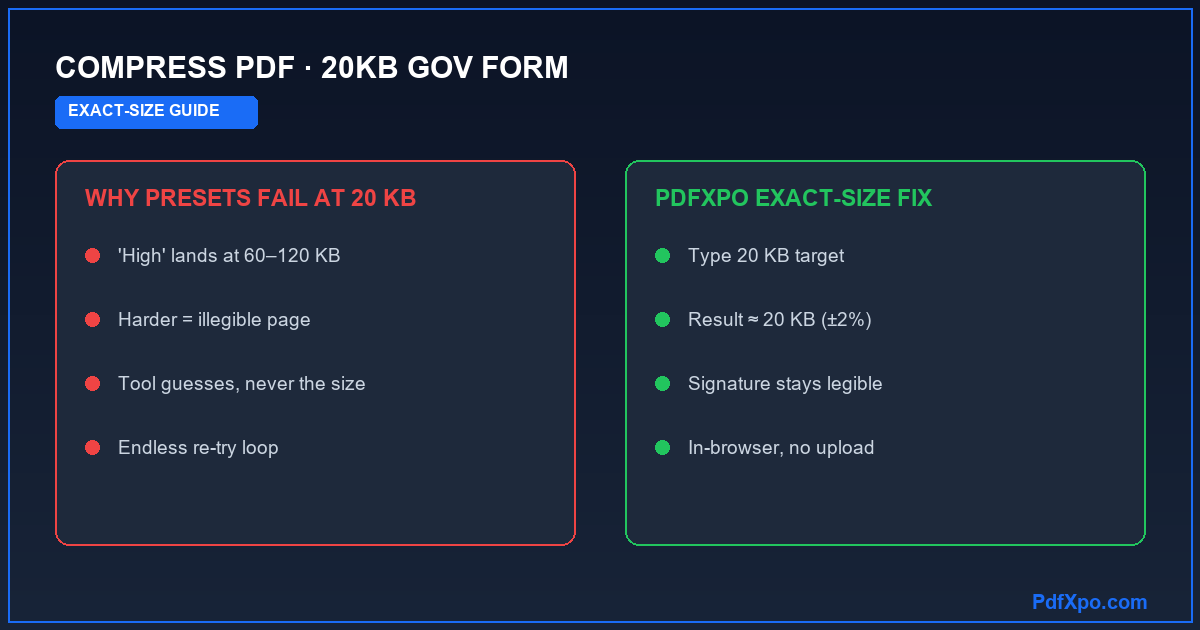
Most "compress PDF" tools offer three presets — low, medium, high — and aim at a vague quality level rather than a size. At a target as tight as 20 KB that approach falls apart: a "high" setting often lands at 60–120 KB (still too big), while pushing harder can crush a page into an illegible blur. The tool is guessing, and 20 KB leaves no room for guessing.
PdfXpo's exact-size mode works differently. You type 20 KB and the engine works backwards from that number, testing compression levels until the file lands within roughly 2% of it. For the kind of content that belongs at 20 KB — a signature, a short declaration, a single light page — it can hit the target while keeping the mark as legible as 20 KB physically allows.
What can realistically be compressed to 20 KB
It is worth being honest about the physics. A 20 KB PDF can comfortably hold:
- A scanned signature or initial.
- A single-page text form or short declaration.
- A simple black-and-white scan with limited detail.
A dense, multi-page colour document cannot be squeezed to 20 KB without losing readability — no tool can break physics. If a portal asks for a full multi-page document at 20 KB, double-check whether the limit really applies to that file or to a single-page item like a signature.
How to compress a PDF to exactly 20 KB
- Save the page or signature as a single PDF.
- Open PdfXpo's Compress to Exact Size tool and drop the PDF in.
- Type 20 KB as your target.
- Compress, open the result to confirm it is still legible, and download. It lands within about 2% of 20 KB.
Fixing common "compress to 20 KB" problems
- The result is still over 20 KB — the source is too detailed for 20 KB; reduce the content (single page, black-and-white) or check the real requirement.
- The text became unreadable — generic compressors over-crush; the exact-size approach keeps it as clear as 20 KB allows, but very tiny targets are inherently limited.
- The portal wants an image, not a PDF — sign or scan as the format the field actually requires.
Before you upload your 20 KB file
- Confirm the portal really wants 20 KB for this specific item.
- Compress to the exact 20 KB target.
- Open the file and confirm it is legible.
- Keep the full-size original — PdfXpo never alters it.
A worked example
A portal asks for a signed declaration at 20 KB or less. Your scanned signature page comes out at 240 KB — twelve times too big. A "high compression" preset drops it to around 90 KB and stops there; pushing further makes the signature a grey smudge. In PdfXpo you type 20 KB, compress, and the page lands at about 20 KB with the signature still recognisable, because the engine aimed at your number instead of guessing at a quality level.
How PdfXpo hits an exact file size — and why presets cannot
Almost every "compress PDF" tool online gives you three vague buttons — low, medium or high. You pick one, wait, download, and only then discover the new size, which is almost never the figure a portal demands. PdfXpo's exact-size mode is built the opposite way round. You type the size you actually need — 20 KB, 50 KB, 200 KB, 300 KB or 1 MB — and the engine works backwards from that target, testing compression levels until the file lands within roughly 2% of it. There is no trial and error and no re-uploading a PDF that is still a few kilobytes too big. You get a document that clears the limit on the first attempt while staying as sharp and legible as the size allows.
Why "file too large" keeps coming back
Three different problems all show up as the same red error, and only one of them is fixed by compressing:
- Size — the PDF is over the portal's KB or MB cap. This is the one an exact-size compressor solves.
- Dimensions or page count — some portals also limit the page size or the number of pages in a single upload.
- Format — the portal wants a PDF and you uploaded a JPG (or the other way round).
If compressing the file does not clear the error, the problem is dimensions or format rather than size — and knowing which one you are hitting saves a great deal of guesswork at the upload screen.
Documents are PDFs; photos and signatures are images
This is the single most common mix-up on exam and government portals, and it is worth getting right. A passport photograph and a specimen signature are usually JPEG images with their own tiny KB limits. Certificates, mark sheets, declarations, statements, ID scans and the application form itself are PDF documents. PdfXpo is a PDF tool, so it is the right fit for the document side — shrinking a scanned certificate or a multi-page form to the exact PDF size the portal accepts. For a JPEG photo or signature you would use an image resizer instead. Uploading the wrong file type, or compressing the wrong thing, is the usual reason an upload still fails after you thought you had already "compressed" it.
Your documents never leave your device
Everything PdfXpo does runs locally inside your browser through WebAssembly. When you compress an income certificate, an Aadhaar or national-ID scan, a degree certificate or a bank statement, the file is processed in your own browser's memory and is never sent to any server — unlike Smallpdf, iLovePDF or Adobe, which upload your file to their cloud to process it. For identity and financial paperwork that is precisely the guarantee you want. You can confirm it yourself: open your browser's developer tools, switch to the Network tab, and compress a file — you will see no request carrying your document's contents leave the page. It is also completely free, with no sign-up, no email, no watermark and no daily limit, so you can prepare an entire application's worth of documents in one sitting.
How small is too small? Balancing the limit and readability
It is tempting to compress as hard as possible "to be safe", but going far below a portal's limit can backfire: a certificate squeezed to a fraction of the cap may turn blurry and be rejected at verification for being unreadable. The goal is not the smallest possible file — it is a file that sits comfortably under the limit while staying perfectly clear, and that is exactly what compressing to an exact size gives you. If a portal allows 300 KB, target 300 KB (or a touch under), not 50 KB; you keep the maximum quality the rule permits. Scanning well in the first place helps too: a flat, evenly-lit scan at a sensible resolution compresses far more cleanly than a dark, skewed phone photo, so you reach the target size with more detail intact. When in doubt, compress, open the file, and read it at 100% before uploading — thirty seconds of checking saves a rejected application.
Official source, accuracy and last review
Upload-size rules change between cycles and portal updates, so always confirm the current figures on your form's own official guidelines before you submit — this guide explains the method, but the portal's own notification is the final word. PdfXpo is a free, in-browser PDF toolkit; for the underlying tools see Compress PDF and Compress PDF to an exact size. Related guides: compress a PDF to 50 KB, and portal-specific help such as compressing for a UPSC application or for a NEET application. This page is maintained by the PdfXpo team and was last reviewed in June 2026.
100% Local Privacy
Your files never leave your computer
Local Browser Power
Instant Processing in Browser
Secure Client-Side Processing
Data is handled entirely within your browser for maximum security
How to Compress a PDF to 20KB for a Government Form — Step by Step
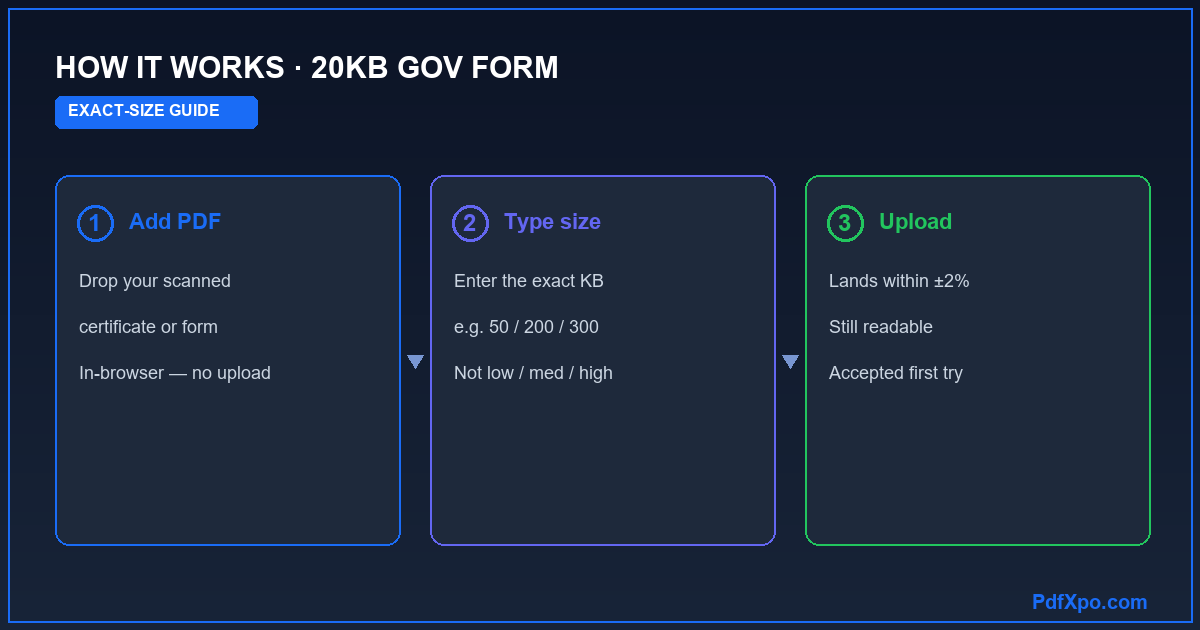
1. Open the free Compress PDF tool at PdfXpo.com — no account, no install, nothing to download. Drag your scanned certificate, mark sheet or document PDF into the box. It loads inside your browser, so the file is never uploaded to any server — which matters when the document carries your name, ID number or financial details.
2. Type the exact size the portal allows — for example 50 KB, 200 KB, 300 KB or 1 MB — into the target-size field. Instead of guessing with a vague 'low / medium / high' slider, PdfXpo works backwards from your number and compresses the PDF until it lands within about 2% of the target.
3. Click Compress, open the result to confirm the text and stamps are still readable, then download it instantly — no watermark, no daily limit, and your original file untouched on your device. Upload the right-sized PDF to the portal and it goes through on the first attempt, with no 'file size exceeded' rejection.
Why PdfXpo for Exact-Size Portal Compression
Hitting a 20 KB limit is the clearest test of why exact-size compression beats presets: no "low / medium / high" button can reliably land on a number that tight, but typing 20 KB and compressing toward it can. PdfXpo aims at your exact figure, lands within about 2%, and keeps a signature or short form as legible as 20 KB allows. It runs in your browser, so the file is never uploaded — and it is free, unlimited and watermark-free, with your original untouched.
Common Questions
Can a PDF really be compressed to 20 KB?
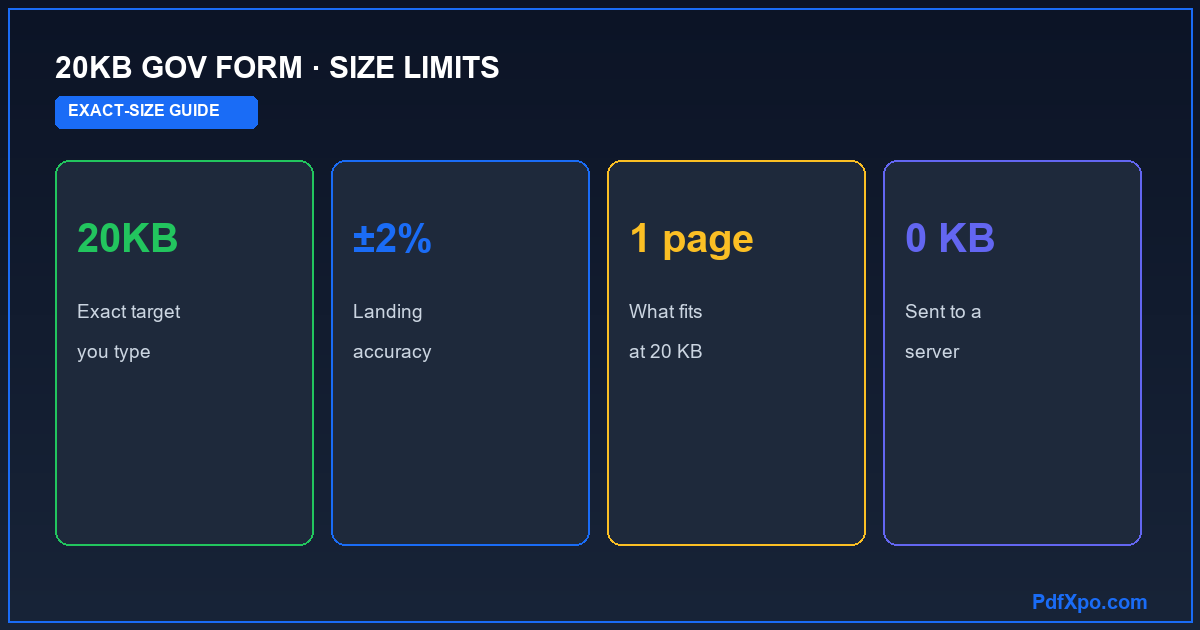
If it is a signature, a single-page form or a simple black-and-white scan, yes — PdfXpo targets 20 KB and lands within about 2%. A dense, multi-page colour document cannot reach 20 KB without becoming unreadable, which is a limit of physics, not the tool.
Why can't a normal compressor hit 20 KB?
Preset compressors aim at a quality level, not a size, so at a tight target like 20 KB they either overshoot (still too big) or over-crush (illegible). PdfXpo works toward your exact KB number instead.
How do I compress a PDF to exactly 20 KB?
Open PdfXpo's Compress to Exact Size tool, drop in your single-page PDF or signature, type 20 KB as the target, and compress. It lands within roughly 2% of 20 KB.
My file won't go under 20 KB — what now?
The content is too detailed for 20 KB. Make sure it is a single page and, if possible, black-and-white — or check whether the 20 KB limit really applies to this document or to a signature-sized item.
Is my file uploaded to reach 20 KB?
No. PdfXpo compresses in your browser via WebAssembly, so the document never leaves your device.
Is it free?
Yes — free, unlimited, no signup and no watermark.