Compress PDF for a NEET Application
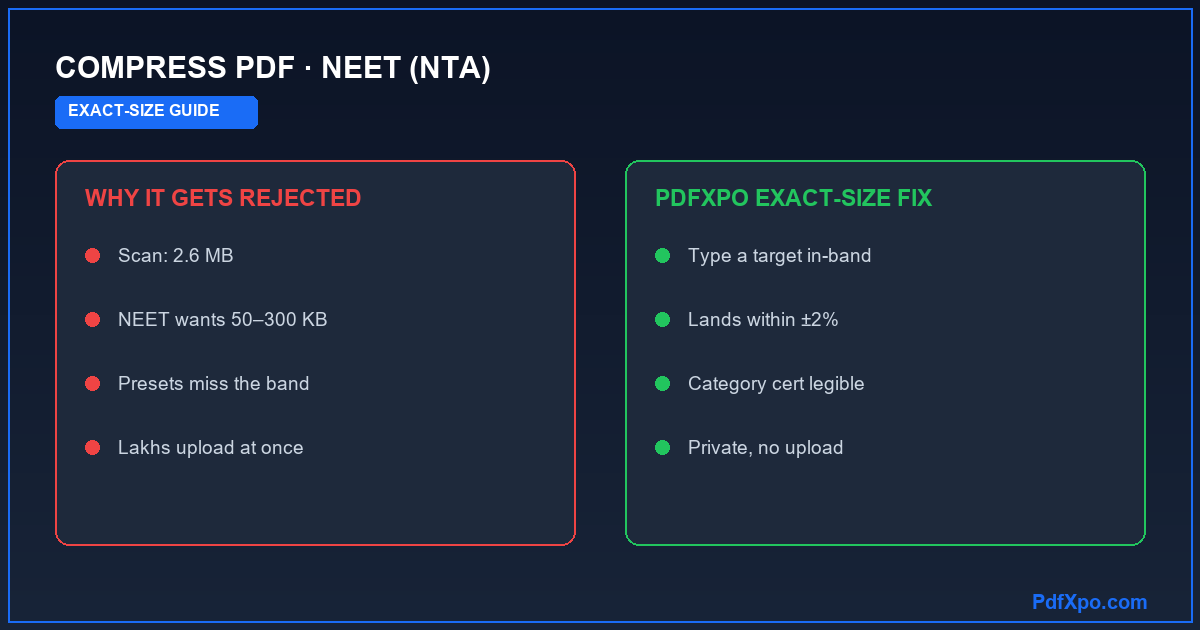
The NTA's NEET application is one of the most upload-heavy forms a student will ever fill. Alongside several photographs there are documents that must be uploaded as PDFs under fixed size limits, and with lakhs of candidates registering in a short window, an oversized file is one of the most common reasons a submission stalls. If you are looking to compress a PDF for a NEET application or get a category certificate under the NEET size limit, here is exactly what to do.
What NEET asks you to upload — and the size limits
NEET separates images from documents, and only some of these are PDFs:
- Postcard photograph and passport photograph — JPEG images, each within a set KB range.
- Signature and left/right thumb impressions — small JPEG images, the signature often only a few KB.
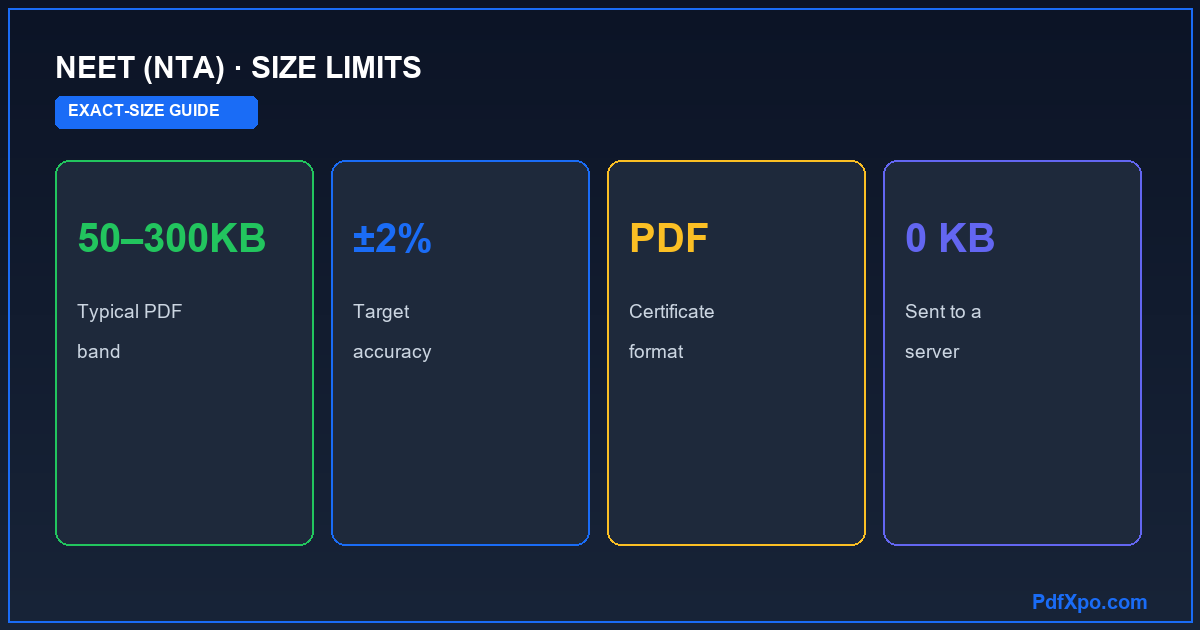
- Class 10 certificate, category certificate (SC/ST/OBC) and PwD certificate where applicable — scanned and uploaded as PDF documents, commonly capped in the region of 50–300 KB each.
- Citizenship / embassy documents for certain candidates, also as size-limited PDFs.
The exact ceilings are set in the current Information Bulletin, so always check it. The photographs and signature are images sized on their own; the certificates are the PDF documents where an exact-size compressor is the perfect fit.
How to compress your NEET certificates to the exact size
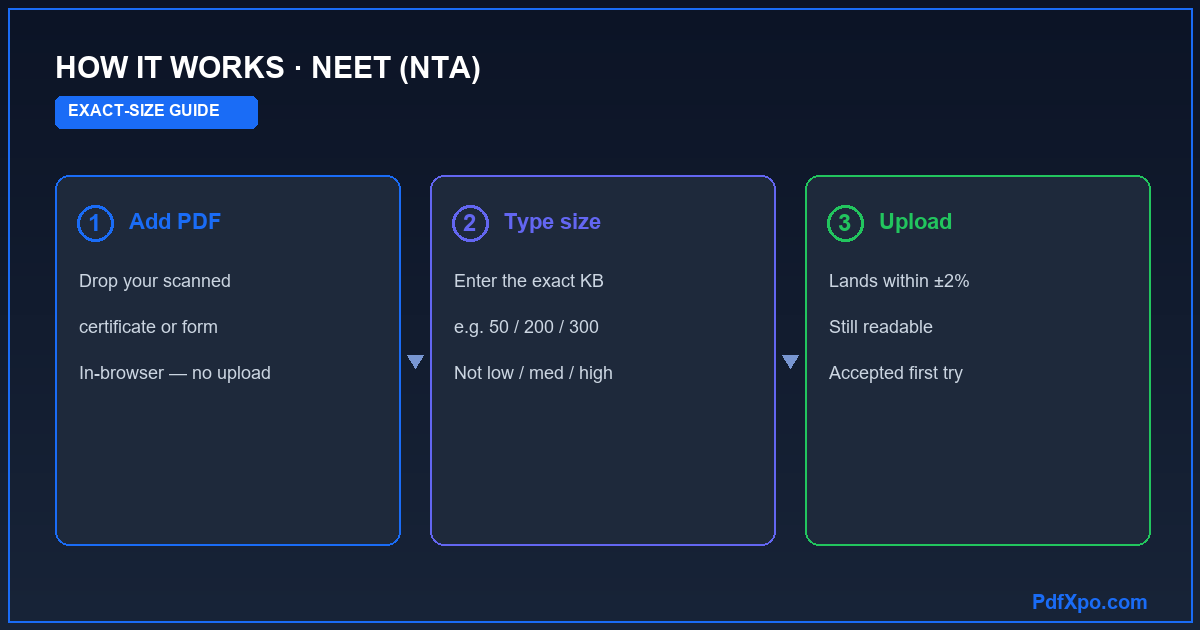
- Scan the certificate and save it as a single PDF.
- Open PdfXpo's Compress to Exact Size tool and drop the PDF in.
- Type the limit from the NEET bulletin — for example 300 KB — as your target.
- Compress, check it is readable, and download. The result lands within about 2% of your figure.
A category or PwD certificate must remain perfectly legible for verification, so PdfXpo preserves the text, stamps and issuing-authority details while removing the redundant scan data that makes the file large.
Fixing the most common NEET upload errors
- "File size should be between X and Y KB" — NEET often sets both a minimum and a maximum. Use the exact-size target to land inside the band, not just under the top.
- "Upload valid PDF" — save the document as a PDF before compressing.
- Photo rejected — that is an image dimension/size issue, handled separately.
- Server timeouts at deadline — a smaller, exactly-sized PDF uploads faster and is less likely to fail under peak load.
A checklist before you submit your NEET application
- Both photographs and the signature prepared as correctly-sized JPEG images.
- Each certificate saved as its own PDF.
- Every certificate PDF compressed to the exact NEET size band.
- Compressed files opened and checked for legibility.
- Originals kept safe — PdfXpo never changes them.
A worked example
Suppose you need to upload an OBC-NCL certificate scanned at 2.6 MB, and NEET allows a PDF of 50–300 KB. A generic "medium" setting might land at 410 KB (over the cap) and "high" might crush the Tehsildar's stamp. In PdfXpo you target 280 KB — comfortably inside the band — and the certificate lands at about 278 KB with the issuing authority, the certificate number and the date all legible for verification.
How PdfXpo hits an exact file size — and why presets cannot
Almost every "compress PDF" tool online gives you three vague buttons — low, medium or high. You pick one, wait, download, and only then discover the new size, which is almost never the figure a portal demands. PdfXpo's exact-size mode is built the opposite way round. You type the size you actually need — 20 KB, 50 KB, 200 KB, 300 KB or 1 MB — and the engine works backwards from that target, testing compression levels until the file lands within roughly 2% of it. There is no trial and error and no re-uploading a PDF that is still a few kilobytes too big. You get a document that clears the limit on the first attempt while staying as sharp and legible as the size allows.
Why "file too large" keeps coming back
Three different problems all show up as the same red error, and only one of them is fixed by compressing:
- Size — the PDF is over the portal's KB or MB cap. This is the one an exact-size compressor solves.
- Dimensions or page count — some portals also limit the page size or the number of pages in a single upload.
- Format — the portal wants a PDF and you uploaded a JPG (or the other way round).
If compressing the file does not clear the error, the problem is dimensions or format rather than size — and knowing which one you are hitting saves a great deal of guesswork at the upload screen.
Documents are PDFs; photos and signatures are images
This is the single most common mix-up on exam and government portals, and it is worth getting right. A passport photograph and a specimen signature are usually JPEG images with their own tiny KB limits. Certificates, mark sheets, declarations, statements, ID scans and the application form itself are PDF documents. PdfXpo is a PDF tool, so it is the right fit for the document side — shrinking a scanned certificate or a multi-page form to the exact PDF size the portal accepts. For a JPEG photo or signature you would use an image resizer instead. Uploading the wrong file type, or compressing the wrong thing, is the usual reason an upload still fails after you thought you had already "compressed" it.
Your documents never leave your device
Everything PdfXpo does runs locally inside your browser through WebAssembly. When you compress an income certificate, an Aadhaar or national-ID scan, a degree certificate or a bank statement, the file is processed in your own browser's memory and is never sent to any server — unlike Smallpdf, iLovePDF or Adobe, which upload your file to their cloud to process it. For identity and financial paperwork that is precisely the guarantee you want. You can confirm it yourself: open your browser's developer tools, switch to the Network tab, and compress a file — you will see no request carrying your document's contents leave the page. It is also completely free, with no sign-up, no email, no watermark and no daily limit, so you can prepare an entire application's worth of documents in one sitting.
How small is too small? Balancing the limit and readability
It is tempting to compress as hard as possible "to be safe", but going far below a portal's limit can backfire: a certificate squeezed to a fraction of the cap may turn blurry and be rejected at verification for being unreadable. The goal is not the smallest possible file — it is a file that sits comfortably under the limit while staying perfectly clear, and that is exactly what compressing to an exact size gives you. If a portal allows 300 KB, target 300 KB (or a touch under), not 50 KB; you keep the maximum quality the rule permits. Scanning well in the first place helps too: a flat, evenly-lit scan at a sensible resolution compresses far more cleanly than a dark, skewed phone photo, so you reach the target size with more detail intact. When in doubt, compress, open the file, and read it at 100% before uploading — thirty seconds of checking saves a rejected application.
Official source, accuracy and last review
Upload-size rules change between cycles and portal updates, so always confirm the current figures on the official NTA NEET portal before you submit — this guide explains the method, but the portal's own notification is the final word. PdfXpo is a free, in-browser PDF toolkit; for the underlying tools see Compress PDF and Compress PDF to an exact size. Related size guides: compress a PDF to 50 KB for a form and compress a PDF to 20 KB. This page is maintained by the PdfXpo team and was last reviewed in June 2026.
100% Local Privacy
Your files never leave your computer
Local Browser Power
Instant Processing in Browser
Secure Client-Side Processing
Data is handled entirely within your browser for maximum security
How to Compress PDF for a NEET Application — Step by Step
1. Open the free Compress PDF tool at PdfXpo.com — no account, no install, nothing to download. Drag your scanned certificate, mark sheet or document PDF into the box. It loads inside your browser, so the file is never uploaded to any server — which matters when the document carries your name, ID number or financial details.
2. Type the exact size the portal allows — for example 50 KB, 200 KB, 300 KB or 1 MB — into the target-size field. Instead of guessing with a vague 'low / medium / high' slider, PdfXpo works backwards from your number and compresses the PDF until it lands within about 2% of the target.
3. Click Compress, open the result to confirm the text and stamps are still readable, then download it instantly — no watermark, no daily limit, and your original file untouched on your device. Upload the right-sized PDF to the portal and it goes through on the first attempt, with no 'file size exceeded' rejection.
Why PdfXpo for Exact-Size Portal Compression
A NEET certificate that fails to upload can cost a student a whole attempt, so precision matters. PdfXpo lets you set the exact KB the NTA bulletin specifies — and where NEET sets a minimum-to-maximum band, you can land inside it rather than just under the cap. It compresses within about 2% while keeping category and PwD certificates fully legible, and it runs entirely in your browser so a student's personal documents are never uploaded. Free, unlimited and watermark-free.
Common Questions
What is the document size limit for NEET?
NTA sets KB ranges for each item: tiny JPEG limits for photographs and signature, and PDF caps (often around 50–300 KB) for certificates such as category and PwD documents. The exact figures are in the current Information Bulletin. PdfXpo compresses your certificate PDFs to that exact size within about 2%.
How do I compress my NEET category certificate to under 300 KB?
Open PdfXpo's Compress to Exact Size tool, add the certificate PDF, type 300 KB as the target, and compress. It lands within roughly 2% of 300 KB while keeping the certificate readable.
NEET says the file must be between a minimum and maximum size — how do I hit that?
Set the exact-size target near the middle of the band. Because PdfXpo aims at a specific number rather than a vague preset, you land inside the allowed range instead of overshooting or undershooting.
Can PdfXpo size my NEET photographs?
Those are JPEG images, so use an image resizer for the postcard photo, passport photo and signature. PdfXpo handles the certificate PDFs.
Is it safe to compress my NEET documents online?
Yes. PdfXpo runs in your browser via WebAssembly, so your certificates never leave your device and are never uploaded.
Is the NEET PDF compressor free?
Yes — free, unlimited, no signup and no watermark.